
Duskwood Farm
From Forest to Front Door: How Duskwood Farm Built a Holiday Wreath Business in Rural Nova Scotia
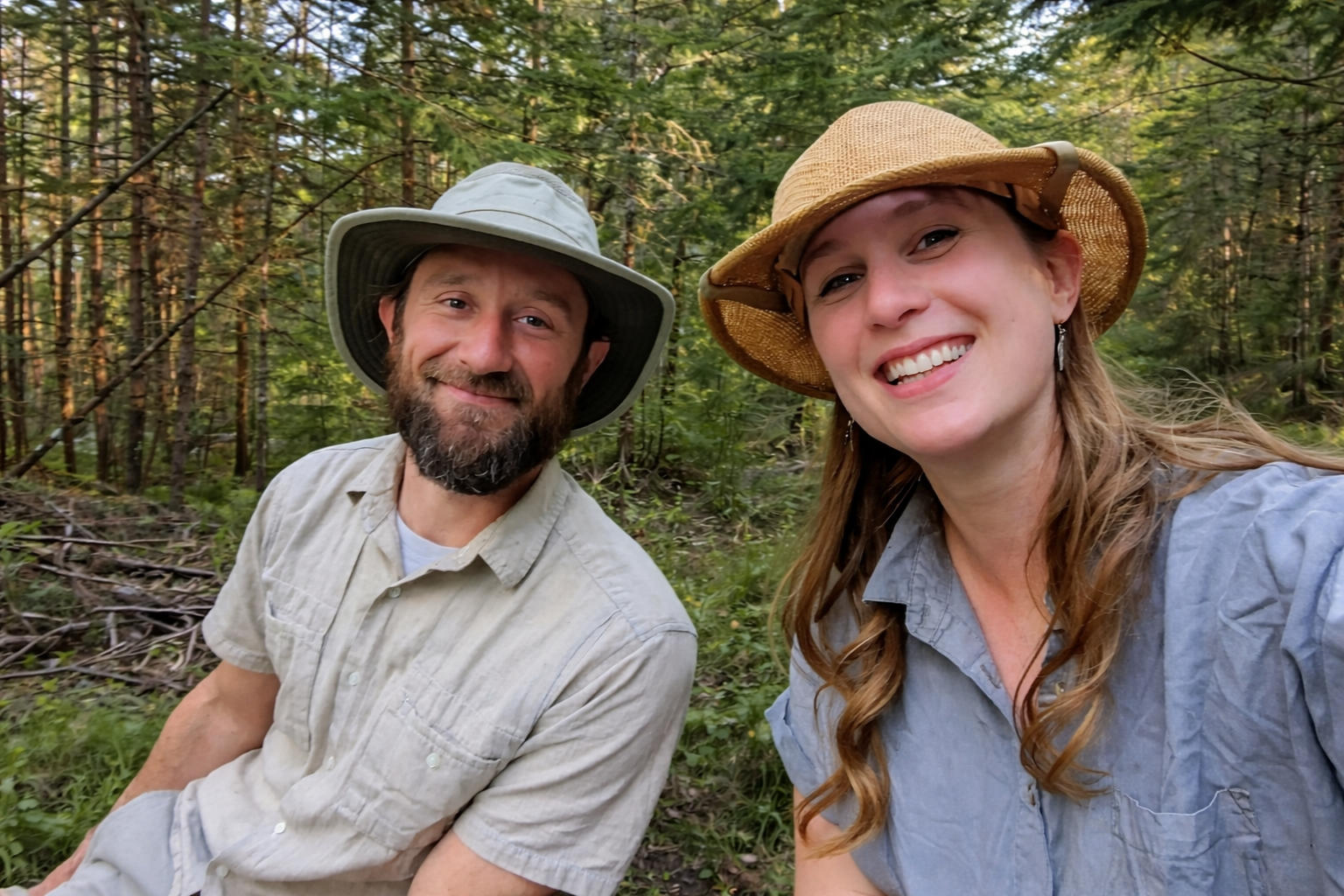
When Tikvah Mindorff and Tyler Simpson packed their belongings into a camper trailer and drove halfway across Canada, they weren’t chasing a carefully mapped business plan. They were chasing a lifestyle—and a dream that had been years (maybe even decades) in the making. Today, that dream has taken root as Duskwood Farm, a growing wreath and greenery business based in New Germany, Nova Scotia. It is a story of experimentation, persistence, and learning to build a business that serves both the land and their lives.
A Cross-Country Adventure
Before landing in Nova Scotia, Mindorff and Simpson lived in Ontario, where they hoped to buy land and start a farm. But the economics simply didn’t work.
“We had tried looking around for property out there,” Simpson recalls. “But the prices were a bit out of our reach.”
Discouraged but undeterred, the couple broadened their search across the country. Soon, they discovered that in Nova Scotia, land could be purchased outright with their savings.
“We basically just uprooted ourselves,” Simpson recalls. “Packed everything into a camper trailer and moved across the country.”
The move was bold and largely improvised. They arrived without a specific property selected and began visiting potential farms in person before finding the one that would eventually become Duskwood.
For Simpson, the desire to live and work close to nature started early. “For me, it started young,” he says. “I always just wanted to try things for myself and build a cabin in the woods.”
Mindorff shared that vision, and together they set out to create a property that could support both their lifestyle and a sustainable income.
Learning What Works
The couple officially launched Duskwood Farm in July 2021, when they purchased their property in New Germany. At first, their plans resembled those of many small farms: animals, food products, and potentially selling meats.
But real life and personal growth quickly reshaped their plans.
“You form attachments with animals,” Simpson explains. “And when it comes time for slaughtering, it’s a hard thing to do.”
After a short stint raising chickens and goats, the couple realized that livestock production didn’t feel right for them. It was that realization that pushed them to look more closely at the land itself.
Their property, they soon discovered, was once a Christmas tree lot, filled with balsam fir and other greenery. Mindorff – backed by her experience in business management and accounting – began researching how to make use of those natural resources.
“I spent a considerable amount of time figuring out how to monetize our woodlot, including having woodlot assessments done,” recalls Mindorff. “Then I joined the Christmas tree association as a volunteer board member to learn more about the industry. After that, I ran financial spreadsheets, forecasting scenarios, and took a job to learn the business from a successful farm.”
Mindorff’s deep-dive into the industry led the couple to start harvesting evergreen brush and – eventually – producing their own handcrafted Christmas wreaths.
A Business Takes Shape
This directional shift would prove to be an important one.
Today, Duskwood Farm specializes in handcrafted holiday wreaths made from balsam fir and other greenery harvested directly from their property. One of their most popular products – among many – is the Acadian wreath, which blends several types of greenery for a fuller, more colourful design.
“It’s a mixture of different types of greenery, not just balsam fir,” Mindorff points out. “When you put them next to each other, the Acadian is just ‘wow’.”
Although some equipment is involved, each wreath is largely handmade – a big part of the product’s appeal. Simpson and Mindorff harvest, process, and assemble the materials themselves, often cutting greenery weekly during production season.
Sustainability is also a top priority.
“We always wanted to have a product that is fully biodegradable or recyclable,” says Simpson. That commitment has led them to replace plastic decorations with natural materials like real pinecones and to experiment with wood or other alternatives for ornaments.
Pursuing Underserved Markets
Despite being situated in a province known as a global centre for Christmas greenery, Duskwood Farm chose not to rely on local sales.
“Nova Scotia is basically the Christmas tree and Christmas wreath capital,” Simpson noted. “So instead of trying to fight tooth and nail to get the sales here, we thought ‘why not search abroad?”
It turns out that this pursuit of underserved markets was wise. Much of their business now happens online, with wreaths shipped to customers across Canada and beyond. Sales are split roughly between
direct consumers and business clients.
So far, growth has been largely organic, powered by effective word-of-mouth from happy customers and a creative referral program.
“Referrals account for the majority of our growth over the last couple years,” Mindorff explains. “We get one referral, and that’s pretty much all we can handle.”
Support From CBDC
As wreath demand increased, the couple needed a proper workspace. Their first wreath production season took place in a temporary tarp-covered structure.
“It was not a comfortable work environment,” Mindorff admits with a laugh.
Simpson agrees.
“We had a successful year, fulfilled the shipment orders, and everybody was very happy with the product,” he recalls. “But we realized we couldn’t keep going in a little shack; we needed to move our barn along faster.”
To finish building a permanent barn for production and storage, they turned to South Shore Opportunities CBDC.
With CBDC’s flexible financing, they were able to complete structural improvements, install a concrete floor, and add critical supports to the building. The new workspace allowed them to increase production and operate more efficiently (and more comfortably).
At around the same time, the company also accessed a microgrant through the Canada Digital Adoption Program, enabling them to build their website and level-up business operations.
Milestones and Moments of Pride
For Mindorff and Simpson, success isn’t measured by a single breakthrough but by steady progress each year.
“I would say almost every year is a proud moment after fulfillment happens,” Simpson reflects.
Even when challenges arise—like a postal strike in 2024 that disrupted shipping during the holiday season—they’ve managed to find solutions and keep customers satisfied.
“We had to pack everything up, drive it to Halifax, and get it shipped out on time,” says Simpson. “And we still managed to do it.”
Mindorff beams when reflecting on the company’s exceptional customer retention rate.
“We really care a lot about the people we work with,” she says with a smile. “That personal touch goes a long way.”
Looking Ahead
The future of Duskwood Farm is still revealing itself, but that’s intentional. Rather than pursuing rapid expansion, the couple is focused on steady, sustainable growth.
“We’ve kind of decided to aim for about 10 percent growth each year,” Simpson said. “Something that’s manageable for us.”
They’re also exploring new efficiencies in production and considering when - or if - to bring in more employees. The couple notes that they recently recruited Simpson’s parents – both retired – to help boost production capacity and ‘test the waters’ for the expansion of their labour force.
For now, though, the business remains deeply personal, shaped by their partnership and their connection to the land.
“Our vision was to live and have a business in the woods that actually made money and that we could have a future with,” Mindorff says.
After several years of experimentation and hard work, that vision is beginning to take shape—one handcrafted wreath at a time.