
How Todd MacDougall turned an observation at an Alberta gas station into a patent-pending product and a 2026 regional Spark Competition winner
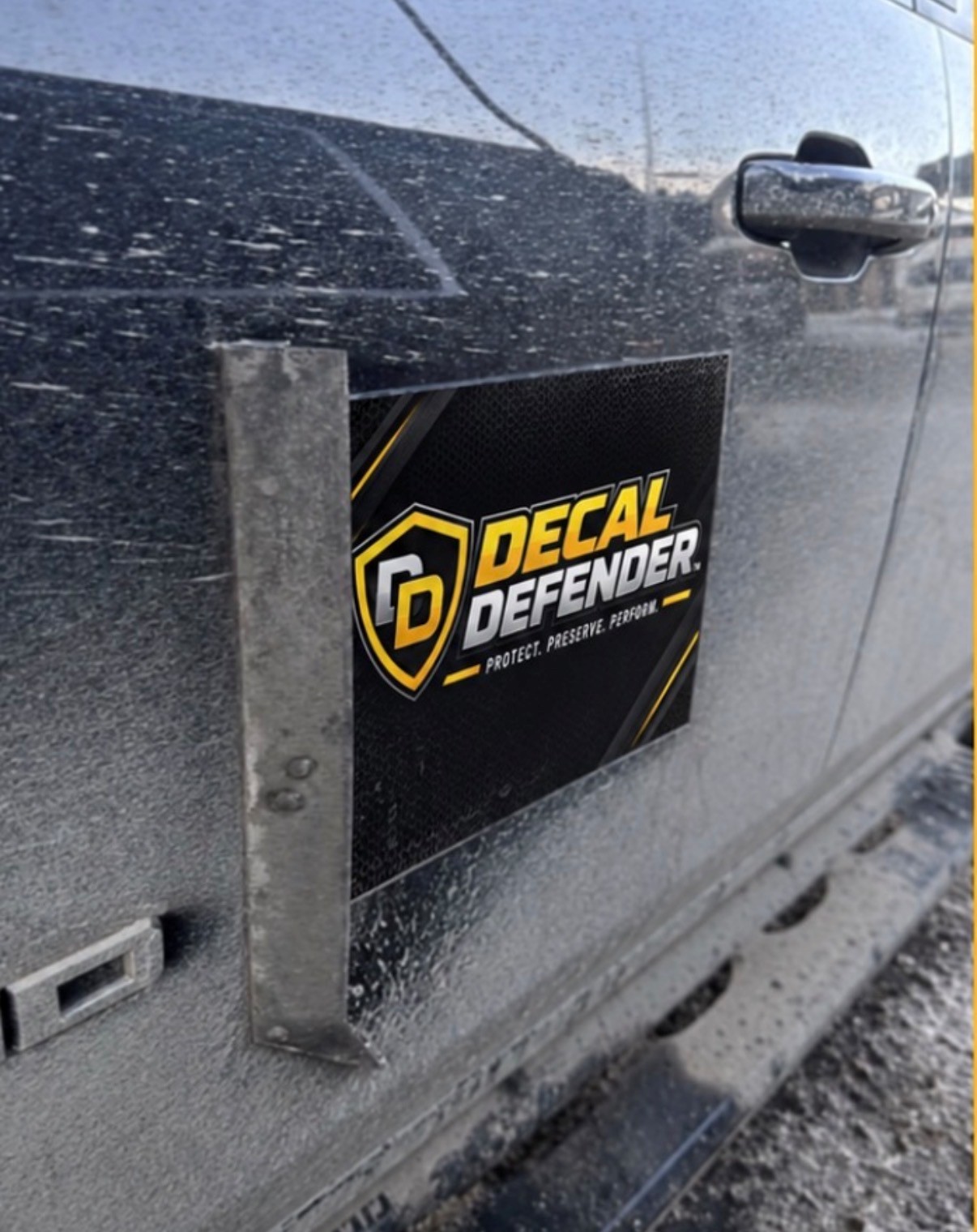
Todd MacDougall was refueling in Fort McMurray when a small patch on his dirty vehicle caught his attention. Just behind the fuel door, a narrow strip of the body was still pristine, shielded from the rain, mud, and grit that coated everything around it. Nearby, another vehicle carried a company decal that was so dirty it was difficult to make out.
The two observations clicked together.
“That’s where it sparked the idea,” MacDougall recalls. “If I made that slightly bigger, it would protect a bigger area of the vehicle.”
He couldn’t stop thinking about it. That protected strip would eventually become the starting point for Decal Defender; his pre-launch business built around a deceptively simple idea: placing a deflector ahead of a decal so road debris is directed away from it.
A Problem Hidden in Plain Sight
The idea was grounded in MacDougall’s years working in multiple energy sectors across Canada. Mainly on large projects, decals and graphics do more than advertise a company. They identify fleet vehicles, communicate safety information, and mark equipment. Keeping them visible can be a worksite requirement, especially when many similar vehicles must be identified quickly and accurately.
“Keeping decals and markings visible isn’t always a choice,” MacDougall explains. “On many industrial projects, it’s a site requirement to keep company decals clean all the time. Yet repeated washing, squeegeeing, and exposure to harsh conditions can wear graphics down, while replacement takes time and money. MacDougall had watched that cycle play out often enough to know there was room for another approach. “Even for any business owner, why wouldn’t you want your branding to stay clean and visible.”
Decal Defender is designed as a self-installed deflector, similar in principle to the visor mounted above a vehicle window. Attached just ahead of a logo or marking, it is intended to redirect rain, mud, and road debris away from the area behind it. Different shapes can suit rounded or square graphics, and MacDougall is also exploring versions for longer areas and higher-impact applications.
“It’s a simple solution to a common industry problem,” he says. “It deflects road debris away from side logos and decals.”
During early testing on his own vehicle, he placed an unlaminated piece of paper behind a prototype and drove for weeks on wet, muddy dirt roads. While the paper still accumulated some dirt, it remained noticeably cleaner than expected. More formal product development is still underway, but that simple real-world test gave him confidence in the concept.
While initially designed to protect company logos and side decals, the concept has broader applications. Commercial vehicle numbers, identification markings, and hazard placards must remain visible and legible to meet regulatory requirements. By helping reduce the buildup of mud, dirt, and road spray, Decal Defender could improve compliance, reduce maintenance and replacement costs, minimize downtime, and contribute to safer roads.
Learning the Invention Business
Turning the observation into a business demanded an education of its own. MacDougall held the idea in his head for roughly two years before deciding to pursue it seriously. He contacted an inventor he knew and was referred to patent lawyers in Vancouver. Searches in Canada and the United States found no equivalent product, he says, opening the way for him to proceed with a patent application.
“I didn’t know the process at all,” he says. “I just figured it out.”
That meant learning how to work with patent professionals, sketching new variations, making some prototypes himself, and paying to have others produced. Each conversation suggested another possible use, from commercial fleets and heavy equipment to hazard placards and vehicle-accessory markets.
The process was neither quick nor inexpensive. MacDougall estimates he has personally invested about $40,000 prior to support received through Spark, while continuing to work full-time, operate a small business, and raise a family. Answers from lawyers and new prototypes could take weeks or months, making momentum difficult to maintain.
“Honestly, you just have to keep chipping away at it,” he says. “I realized early on this isn’t a quick process.”
Throughout the journey, MacDougall says his wife, Kortnie, was one of his biggest supporters. While Decal Defender may have started as his idea, she was involved in countless discussions and brainstorming sessions along the way. From reviewing ideas and prototypes to helping weigh important decisions, her support and patience played a significant role in helping bring the concept to life.
“When I think about it, I actually kind of had to sell the idea to her in the beginning,” he laughs. “I guess she bought it.”
The Spark That Changed the Pace
A connection with CBDC helped move Decal Defender closer to the finish line. MacDougall had been in touch with a CBDC staff member about another project he was working on when she sent him information about Nova Scotia’s annual Spark Competition.
By then, years of thinking and talking about the product had prepared him well. He had presentation material ready, and public speaking was already part of his working life. He applied, was selected to pitch, and won first place in the 2026 competition for his region.
MacDougall says he felt he had a good shot but tried to keep his expectations in check.
“I knew I had a good chance, but I wasn’t getting my hopes up,” he says. “When Decal Defender was called for first place, it was pretty surreal. It was an amazing feeling and a great achievement, but I knew there was still a lot of work to do.”
The recognition provided validation for years of persistence and helped reinforce his belief in the opportunity ahead.
Until then, he had kept the project largely to himself, with no public posts announcing what he was building. Spark helped turn a private, persistent effort into something that had been heard, assessed, and backed.
The financial award mattered, but MacDougall says the network surrounding it has been just as valuable. “The funding definitely helps, but also the contacts,” he says, pointing to the guidance and connections available through CBDC and municipal, provincial, and federal partners. “To have the help and better guidance took a lot of weight off my shoulders.”
That support has also changed how he sees his place in the broader business community. If someone approaches him with an idea of their own, he now has contacts to point them toward.
Bringing the Opportunity Home
For MacDougall, Decal Defender is also tied to a homecoming. After many years away, he and his wife, Kortnie, chose to move their family back to Cape Breton. Within about six months, the Spark opportunity arrived. The timing reinforced his hope that the business can grow from the place they chose to call home.
His immediate milestone is a successful launch. He is building the brand, developing industry connections, and considering a mix of online sales, retail distribution, and partnerships across Canada and the United States. Commercial and industrial fleets are the initial focus, with mining, energy, construction, transportation, and municipal operations all offering potential applications.
The longer-term ambition is to manufacture in Cape Breton. MacDougall knows the business may need to begin modestly, perhaps with rented production space and a small team, and that rising demand could require outside manufacturing support. Still, his vision is local: a facility of his own and meaningful employment in the community over the next few years. He also hopes to one day give back to Fort McMurray, where the idea for Decal Defender first took shape. “Fort McMurray gave me so much throughout my career,” he says. “I’d love the opportunity to give something back.” First comes the launch, but he’s already thinking bigger. “Once we gain some traction with sales, you’ll probably see me on Dragon’s Den,” he says with a laugh.
For now, the work continues between his career, family life, early-morning emails, late-night decisions, and another round of product refinements. Decal Defender has not yet reached the market, but it has already crossed two thresholds that once seemed distant: a patent-pending concept and the backing to keep moving forward.
As MacDougall puts it, “I realized at one point I was too invested to walk away, so now I’m fully committed to seeing it through.”
Thank you to the Atlantic Canada Opportunities Agency (ACOA), who collaborate with us to support small businesses and aspiring entrepreneurs. Together, we will continue to build a stronger Atlantic Canadian economy, fostering job growth and strengthening our rural communities.