
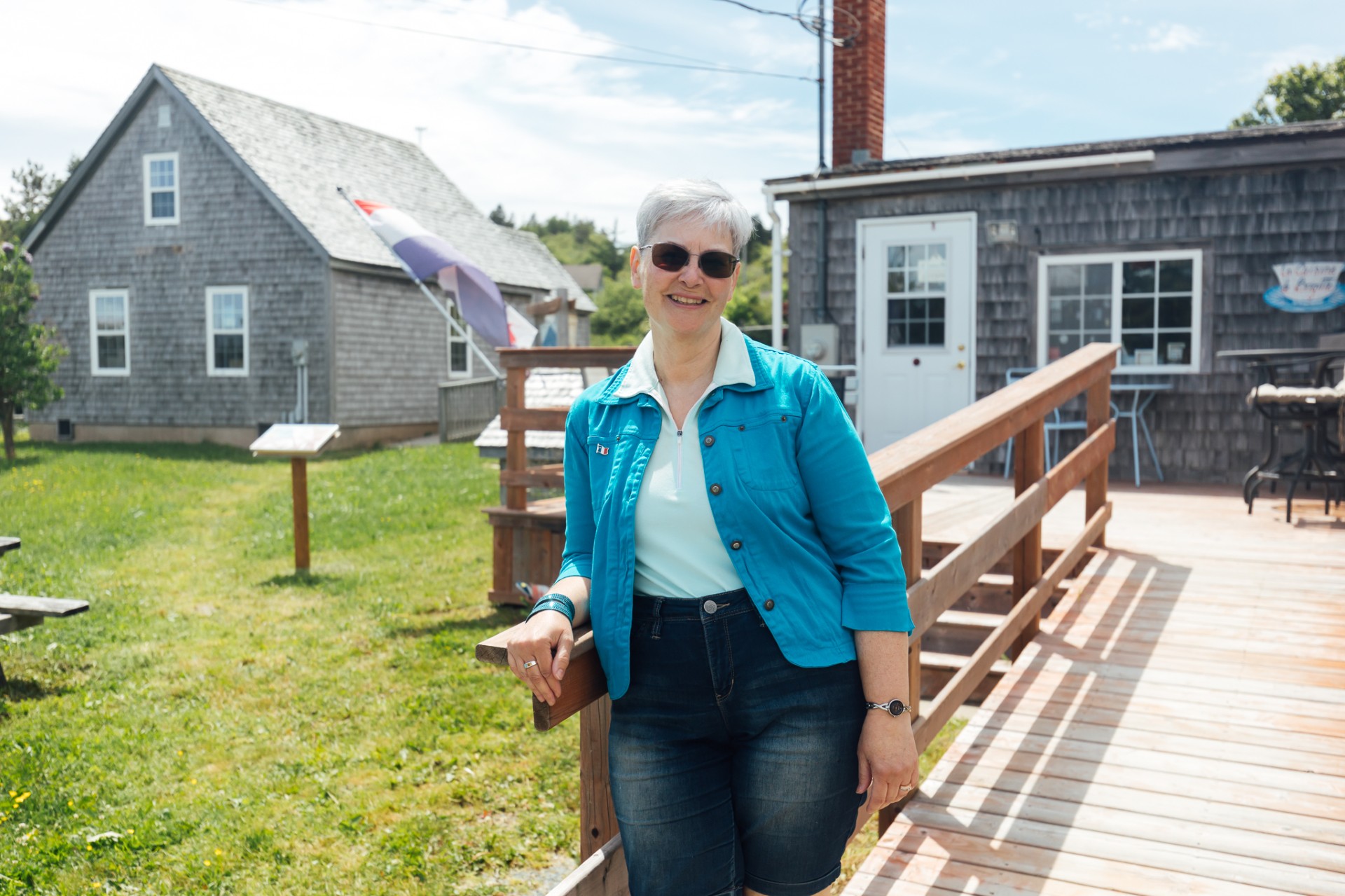
In West Chezzetcook and Grand Désert, heritage is not something sealed behind glass. It lives in family names, old recipes, French classes, tea-room conversations, summer visitors, and the volunteers who believe a community’s story is worth carrying forward.
For Valerie Bellefontaine, Vice-Chair of L’Acadie de Chezzetcook Association, that story is personal. French was her first language at home, spoken with her grandmother. But outside the home, things changed.
“My mom will tell the story and say, one day, I just turned it off,” Valerie says. “And didn’t speak it again.”
At the time, no one around her saw that as a loss. Today, she sees it differently. “It was sad, really, but fortunately it’s not like that anymore.”
That shift from loss to renewal is at the heart of L’Acadie de Chezzetcook Association, which began in 1996 and is now marking its 30th anniversary. Founded by Judy Bellefontaine, who saw French language and culture slipping away, the organization started with a proposal to create an Acadian Heritage Museum. Three decades later, it has grown into a historic site with multiple buildings, a museum, a welcome centre, a gift shop, La Grange, Le Cabano, La Cuisine de Brigitte, cultural programming, summer students, volunteers, and now a major new project: the Chezzetcook Inlet Acadian Centre.
“It really was about preserving that culture and history and experience and sharing it with others,” Valerie says.
The urgency was real. West Chezzetcook and Grand Désert sit close to Halifax and Dartmouth, and that proximity shaped the community’s language story. People went to the city for work. English dominated public life. Over time, French was pushed to the margins.
“We are the only Acadian community in HRM,” Valerie says, “and our language was really being lost.”
The association’s work became about more than remembering the past. It became a way to help people recognize the value of what was already around them. “Sometimes you can’t see the forest for the trees when you’re really close,” she says. “You can’t appreciate the beauty of what you have.”
Reclaiming a Living Language
Today, that beauty is easier to see. Visitors come to tour the site, learn about local Acadian life, and experience a community that has worked hard to reclaim its pride. The local French school has also been a turning point. What began as a P-6 school expanded to P-8, and Valerie says the plan is now to grow into a P-12 school over the next few years.
“That changed a lot,” she says. “That was another real pivot point, I think, for the community.”
The shift is generational. French classes and conversational programs have helped adults regain comfort with a language many grew up hearing but hesitated to use. Valerie says some people once felt ashamed because their French did not sound like the French taught in school.
“They were speaking properly,” she says. “It’s just they were using very old words.”
What was once treated as something lesser is now being recognized as a living inheritance.
“I think today we have a whole different appreciation for culture,” Valerie says. “And now it’s about more than just protecting, it’s about promoting. That’s really the next step.”
Breathing New Life into a Historic Landmark
That next step is taking shape inside a landmark building.
When the former community church closed in 2018, its loss was felt deeply. Even for those who were not active parishioners, the building had been a gathering place and part of the community’s emotional landscape. When it became clear it could be sold, volunteers began talking about what might be possible.
“It was a hard thing when the church was closed,” Valerie reflects. “It was a hub for community engagement.”
The association eventually purchased the building and began transforming it into the Chezzetcook Inlet Acadian Centre, a cultural and performing arts venue intended to host concerts, events, community programming, meetings, ceremonies, workshops, and tourism experiences. The original wooden St. Anselm Church was built in 1814, serving the Acadian community for 80 years before being replaced in 1897. The current structure, built with bricks made in a local brickyard and paid for by local families, carries history in its walls.
The renovation has been ambitious. Exterior work included repairs to the brick and steeple, with care taken to preserve the building’s heritage character. Inside, the space has been stripped and rebuilt with new washrooms, storage, a bar, new floors, fresh walls, electrical work, and a stage large enough, Valerie says, to host Symphony Nova Scotia.
“We wanted to maintain it,” she says, “and we wanted to repair it in a way that continued to reflect the heritage aspect of the building.”
Scaling Up with CBDC Blue Water and Other Partners
The scale is unlike anything the association has taken on before. What began 30 years ago as a volunteer-run museum has grown into a more formal organization, with a part-time executive director, summer students, committees, an accountant, a new strategic plan, and partnerships with organizations such as Discover Halifax. The project itself is valued at roughly $3 million, supported by major federal funding, some provincial support, community fundraising, and other partners.
For a small community, the local fundraising has been remarkable. Valerie estimates the community has raised about $125,000 toward the project.
“It is a lot of money,” she says. “And we still have a way to go before we reach our goal.”
CBDC Blue Water became part of the story when the association needed support managing cash flow during the renovation. Traditional financial institutions, Valerie says, were not well suited to the realities of a not-for-profit taking on a project of this size. CBDC understood both the practical need and the community vision.
“CBDC was critical for us last year,” she says. “Their financing allowed us to bridge cash flow gaps and continue construction until the next installments of our grant funding were received.”
The relationship with Development Officer Annie Gagne also brought advice, structure, and encouragement as the organization became more formal.
“Annie and the team at Blue Water had a trust and a belief in our vision,” Valerie says. “It wasn’t just about providing the money either. It was about providing the support.”
Today, L’Acadie de Chezzetcook Association has between 75 and 100 volunteers, with a core group of roughly 20 to 30 people doing much of the ongoing work. Some have been involved since the early days; others joined because the former church project captured their imagination.
“The people that are helping with this particular project, it’s their passion,” Valerie says. “And it’s going to help us see it through.”
That passion is tied to a broader economic vision. The centre is expected to draw visitors, performers, organizations, and event clients to the Eastern Shore, creating opportunities for local accommodations, caterers, florists, printers, event planners, and other small businesses.
“If we do well, they will also benefit,” Valerie says.