
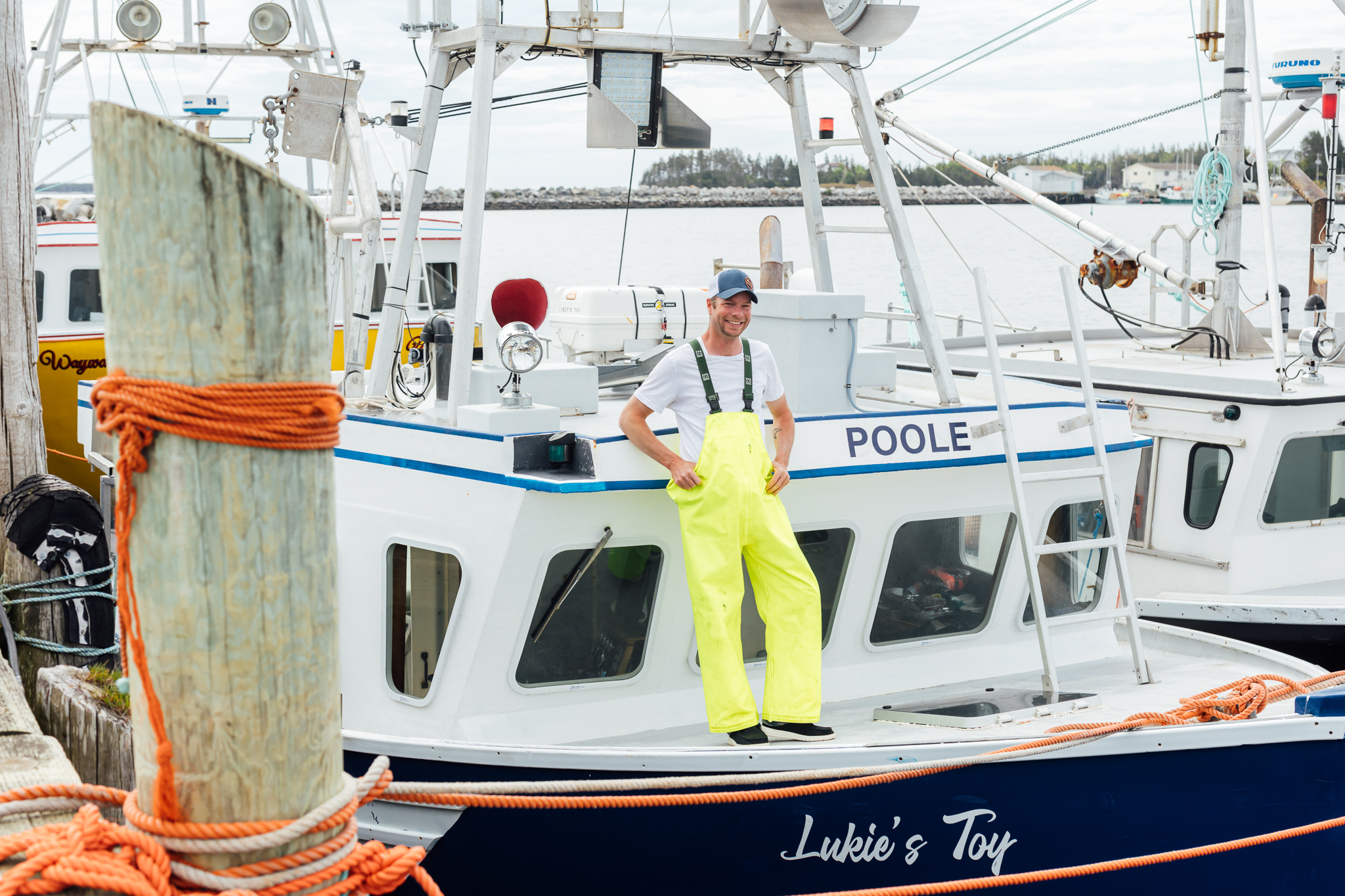
By the time Stephen Poole is tied up for the season in Lockeport, Nova Scotia, the work is far from finished. The traps may be ashore by June 1, but there are buoys to mark and strap, ropes to sort, gear to repair, and decisions to make before the next opening day rolls around near the end of November.
“It’s steady,” Stephen says. “Your six months off isn’t really six months off. There’s always something that you can be doing.”
That rhythm suits him. Stephen is a lobster fisherman, and for him, the pull of the water is both practical and personal. He comes from a fishing family. His grandfather, Freeman Poole, came from Newfoundland to Nova Scotia to fish. His father also lobster fished and dragged, passing along a way of life that Stephen still feels connected to today.
“I just tried to keep up the family tradition of fishing,” Stephen says. “I’m not much of an eight-to-five job kind of guy.”
Before buying his own lobster licence, Stephen spent years offshore scallop fishing. The money was good, especially for a young man in his early twenties. But the work took him away, and life at home was changing quickly.
“I had a daughter, and my daughter just started growing up before my eyes,” he recalls.
The chance to shift into lobster fishing came through an older fisherman from Little Harbour who was ready to sell. The man had been friends with Stephen’s father, and he offered Stephen the opportunity to buy the licence and boat. Stephen took it, stepping into a fishery that was familiar in one sense and entirely new in another.
A Stronger, Safer Vessel
This coming season will be Stephen’s seventh. For the first three years, he fished from a smaller boat, about 34 feet long. It got the job done, but Stephen knew its limits.
“It was just a small little boat,” he says. “To go out in any amount of weather, it was a little sketchier compared to most other boats that were bigger and safer.”
After proving he could make the business work, Stephen began looking for something better. That’s where CBDC Shelburne came in. He had heard good things about CBDC from other fishermen in the area and went to see Heidi Wagner. The process, he says, was straightforward: he wrote up a business plan, submitted it, and waited for an answer.
“It wasn’t very long before Heidi told me the good news,” he says.
With CBDC’s support, Stephen was able to move into a 44-foot boat that gave him more room, more capability, and perhaps most importantly, more safety. Lukie’s Toy had the kind of upgrades his old boat lacked: a newer engine, wheelhouse, electronics, wiring, and equipment that made a meaningful difference on the water.
Long Days, Cold Water
Although technology has changed lobster fishing, it has not changed the hard work itself. The lobster season runs through the harshest part of the year, and Stephen goes when the weather allows. Some days start around five in the morning and end by noon. Other days, especially offshore in the fall, can stretch from two or three in the morning until ten at night.
Then, he says, you sleep for a few hours and go back at it again.
This past winter was especially difficult. Frigid temperatures, snow, and cold water made it hard to get out consistently. Some weeks, Stephen says, getting out twice felt lucky. The work is physical, cold, and long, and the weather remains the part that outsiders often underestimate.
“The weather and the back-breaking work,” he says. “Long, long, long days.”
Still, Stephen speaks about the water with affection. His favourite part of the business is not complicated. It is the independence, the sunrise, and the quiet space of being offshore with a job to do.
“Being out on the water and being your own boss is the best part,” he says. “I can work at my own schedule. I’m not sitting there waiting for a phone call, for someone to tell me that we’re going out.”
Respect for the Sea
He has earned that independence the hard way. In 2017, while working as a bander on another lobster boat, Stephen went overboard and was airlifted for medical care. Some people wondered how he could go back to the fishery after that.
His answer is simple: you do not let one bad moment decide the rest of your life.
“If you get bucked off, you can’t let it stop you,” he says. “But I’ve got respect for the water.”
Respect is a word that fits Stephen’s story. He respects the risks. He respects the old ways. He respects the effort it takes to build something of your own. He also respects the quiet superstitions that come with fishing life, which is why Lukie’s Toy still carries the name it had when he bought it.
“I’m keeping the same name on it,” Stephen says. “They claim it’s bad luck if you change it. It’s a fisherman superstition.”
Today, Stephen usually fishes with one main crew member, a close friend from Lockeport who has been with him since the beginning. The two had worked together on freezer trawlers in the scallop fishery, so Stephen already knew the kind of worker he was.
“Me and him started it together,” he says. “He’s one of my good friends, and we’ve been a team ever since.”
That kind of trust matters in a business where dependable help can be hard to find and where every day on the water depends on people doing hard work well.
Built to Carry On
Like many fishermen, Stephen is clear-eyed about the pressures facing the industry. Fuel costs are up. Bait costs are up. The cost of nearly everything has risen, while lobster prices do not always follow. Early in the season, when the catch can be stronger, prices may be low. Later in the winter, when prices rise, weather and cold water can make it harder to fish.
Even so, Stephen hopes to keep going for years yet. Eventually, he says, he would like to see the boat and business passed on to someone else.
“I’d like to see it go for a while yet until I retire and maybe be able to pass it down to someone,” he says.
That idea of passing something on runs through his life. His father died young, at 44. His mother, who passed away four years ago, encouraged him when he first got into lobster fishing. Stephen says she was one of the people who helped him most.
“She always told me, reach for my goals,” he says.
It is advice he seems to have taken seriously. From offshore scallop boats to his own lobster licence, from a small starter boat to Lukie’s Toy, Stephen has built his livelihood one decision at a time. The work is not easy, and he does not pretend it is. But for a fisherman from Lockeport who values independence, family, and the peace of the water, it is the life that fits.
“Life’s just so short,” he says. “If you want something, get it.”
Thank you to the Atlantic Canada Opportunities Agency (ACOA), who collaborate with us to support small businesses and aspiring entrepreneurs. Together, we will continue to build a stronger Atlantic Canadian economy, fostering job growth and strengthening our rural communities.